Analyzing the Impact of Reviews on AirBnB Booking Rates
How does reviews affect booking rates on AirBnB, specifically focusing on listings in California.

In today’s highly competitive hospitality industry, customer feedback is a crucial determinant of a listing’s success on platforms like AirBnB. Reviews significantly influence booking rates, as potential guests often rely on previous experiences shared by others to make their decisions. Understanding how these reviews impact booking behavior is essential for hosts looking to optimize their listings and attract more guests. This project aims to analyze the impact of reviews on AirBnB booking rates in California using a dataset sourced from Kaggle.
Project Overview:
- Objective: Analyze the impact of reviews on AirBnB booking rates and develop a predictive model to provide actionable insights for hosts.
Dataset: Sourced from Kaggle, titled “AirBnB Listings in California.”
Dataset Features:
- price: The price of the listing.
- availability_365: Number of available days within the year.
- number_of_reviews: Total number of reviews the listing has received.
- number_of_reviews_ltm: Number of reviews in the last 12 months.
- review_scores_rating: Overall rating score.
- review_scores_accuracy: Rating score for accuracy.
- review_scores_cleanliness: Rating score for cleanliness.
- review_scores_communication: Rating score for communication.
- review_scores_location: Rating score for location.
- review_scores_value: Rating score for value.
- host_response_time: How quickly the host responds to inquiries.
- host_response_rate: Host’s response rate.
- host_acceptance_rate: Host’s acceptance rate.
- host_is_superhost: Whether the host is a superhost.
- instant_bookable: Whether the listing is instantly bookable.
- room_type: Type of room (e.g., Entire home/apt, Private room).
- minimum_nights: Minimum number of nights a guest can stay.
- maximum_nights: Maximum number of nights a guest can stay.
- accommodates: Number of guests the listing accommodates.
Business Problem/Hypothesis:
The core of our project revolves around understanding how customer reviews affect booking rates. Specifically, we seek to answer the following research questions:
- How do the number of reviews impact booking rates for AirBnB listings in California?
- How do the quality of reviews impact booking rates for AirBnB listings in California?
- What are the key factors in reviews that contribute to higher booking rates?
Hypothesis
We hypothesize that:
- The number of reviews significantly influences booking rates.
- Higher review scores correlate with higher booking rates.
Methods/Analysis
- Data Cleaning and Preparation: Dropped unnecessary columns, filled missing values, created new features like booking rate, calculated booked_days_365, and normalized features.
- Exploratory Data Analysis (EDA): Visualized distributions and relationships within the data using box plots, scatter plots, and correlation heatmaps.
- Model Training and Evaluation: Used Random Forest and XGBoost Regressors with hyperparameter tuning to predict booking rates. Evaluated models using Mean Squared Error (MSE) and R² Score.
Key Analyses:
Relationship Between Number of Reviews and Booking Rates:
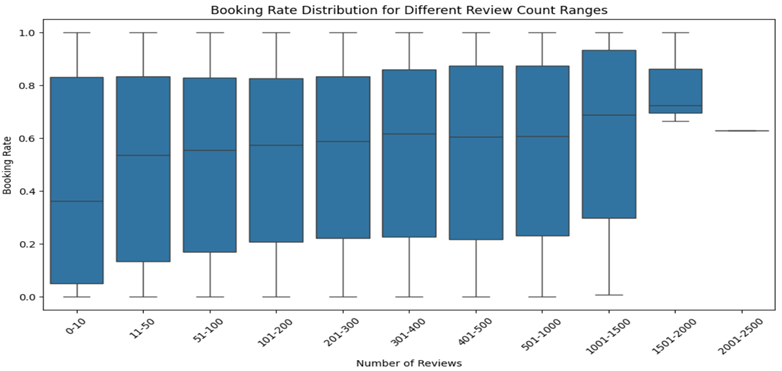
- A box plot was used to visualize booking rate distribution across different review count ranges, showing no clear trend that higher review counts lead to higher booking rates.
Relationship Between Review Scores and Booking Rates:
- Scatter and line plots showed a weak positive relationship between higher review scores and booking rates, indicating that while good reviews help, they are not the sole determinant of booking success.
Key Factors in Reviews:
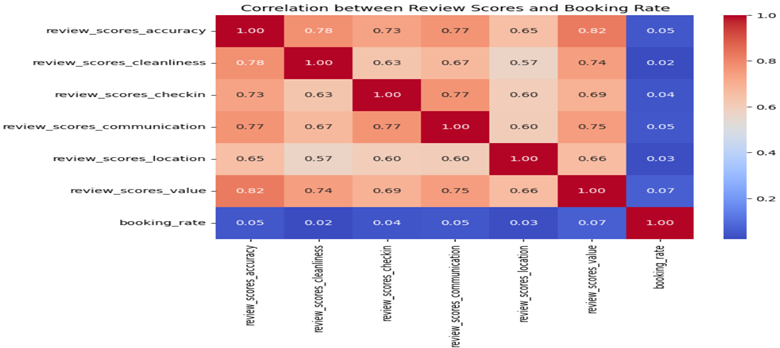
- Correlation heatmaps indicated weak correlations between individual review scores and booking rates, with review_scores_value showing the strongest correlation.
Feature Importance:
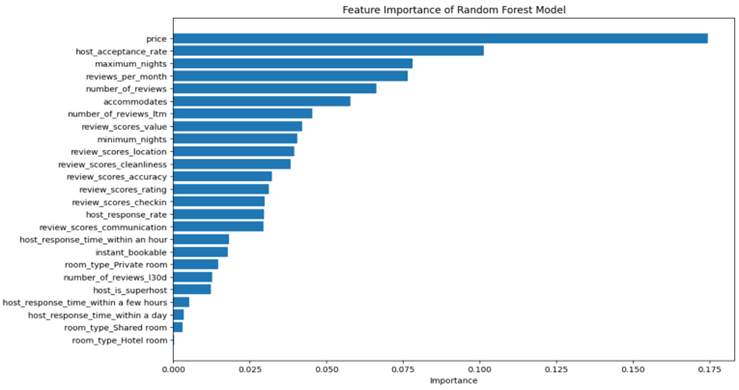
- Random Forest model identified price, host acceptance rate, maximum nights, and reviews per month as significant factors affecting booking rates.
Results
- Random Forest Regressor:
- Mean Squared Error: 0.0778 (before tuning), 0.0794 (after tuning)
- R² Score: 0.4356 (before tuning), 0.4238 (after tuning)
- XGBoost Regressor:
- Mean Squared Error: 0.1115 (before tuning), 0.1050 (after tuning)
- R² Score: 0.1913 (before tuning), 0.2380 (after tuning)
Recommendations
- Optimize Pricing Strategies:
- Implement dynamic pricing and offer discounts for extended stays or last-minute bookings.
- Improve Host Acceptance Rate and Responsiveness:
- Increase response rate and reduce response time. Provide flexible cancellation policies.
- Enhance Property Features:
- Maintain high cleanliness standards and accurate descriptions.
- Leverage Reviews and Guest Feedback:
- Encourage positive reviews and address negative feedback promptly.
Ethical Considerations
- Ensure accurate and honest listings, clear communication, data protection, and ethical use of reviews.
Limitations and Future Work
- Limitations:
- Data quality and completeness, generalizability, and temporal dynamics.
- Future Work:
- Broader data collection, dynamic analysis, advanced predictive models, and continuous improvement.
Conclusion
This study highlights the importance of strategic pricing, host responsiveness, and high property standards in optimizing booking rates. While reviews play a role, they are not the primary drivers of booking success. Future research should incorporate more diverse datasets and advanced techniques to better understand and predict booking rates.
By adopting these insights, AirBnB hosts can improve their listings’ appeal, leading to higher guest satisfaction and increased bookings.
Presentation
Presentation